

Two years ago I gave up on my living room couch. Not because it was uncomfortable, but because the corner where the couch met the bookshelf had quietly become the only place in my flat where I could finish a chapter without checking my phone. I didn't plan it. I just started sitting there. A cushion, a lamp I stole from the bedroom, and suddenly a Sunday afternoon felt three hours longer than it actually was.
That's the thing about creating a cozy reading nook at home: the good ones usually aren't designed. They're discovered, then refined. And most of what I read online about them skips the refining part—the light temperature, the seat depth, the seven dollars of fabric that changes everything. So let me walk you through what actually matters, including the parts I got wrong.
Key Takeaways
- The best nook starts with a spot you already drift toward, not one you invent from scratch.
- Warm light (around 2700K) at head height, angled toward the page, does more for coziness than any piece of furniture.
- You can define a nook without drilling a single hole: a rug, a screen, a curtain, a height change.
- Seat depth and back support decide whether you last twenty minutes or two hours.
- Textiles should be layered cheap on purpose—a $40 rug and a $15 throw beat one expensive armchair accessory.
- Silence matters more than most guides admit. Soft surfaces absorb the noise that breaks concentration.
Find the spot you already use, not the one that looks best on a floor plan
Almost every guide tells you to pick a corner. That's fine as far as it goes, but a corner isn't automatically a nook. Corners collect junk. What you actually want is the spot where you already pause—the chair nobody claims, the end of the hallway near the window, the bit of floor beside the radiator that gets sun between ten and noon.
Watch yourself for a week. Where do you sit when you're waiting for the kettle? Where do you end up when you're on a phone call and you want privacy? Those micro-decisions are data. They tell you which part of your home your body treats as a retreat.
Four objective criteria for choosing the location
Once you have two or three candidate spots, score them against these. I use this list every time I rearrange a room, and it has saved me from at least two bad decisions.
- Natural light, but not direct midday sun. A spot that faces north or gets filtered light is easier on the eyes for long sessions. I once set a chair directly under a south-facing window and abandoned it within a month—the glare made paper feel like a phone screen.
- A nearby outlet. Sounds mundane. It isn't. Without one, you will run an extension cord across a walking path, and you will trip on it. Ask me how I know.
- Away from circulation. If people walk through the spot to reach the kitchen or the bathroom, it will never feel private. Count how many times someone passes through in an hour. More than four, and it's a corridor, not a nook.
- Acoustically soft. Carpet, curtains, upholstered furniture, bookshelves packed with books. All of these absorb sound. A spot near hard flooring and open doorways will always feel busier than it is.
Small spaces pass this test more easily than large ones. A wide-open room has nowhere to hide. A tight corner beside a bookshelf wall already has two boundaries built in.
Light does more for coziness than any piece of furniture
Here's my strongest opinion on this whole subject: if you have a fixed budget, spend it on light before you spend it on a chair. I'll defend that claim until the day I die.

A mediocre chair under good light feels calmer than a beautiful armchair under a harsh ceiling fixture. The reason is simple. Cozy isn't a property of furniture. It's a property of how the space looks at the moment you sit down—the ratio between lit surfaces and shadow. Ceiling lights flatten a room. They illuminate everything equally, which removes the sense of enclosure.
What to buy, roughly what it costs
- A swing-arm floor lamp or wall-mounted reading light you can angle toward the page rather than over your shoulder. In my experience, this single item does about 60% of the visual work.
- A warm bulb, around 2700K, and dimmable if possible. Cool white light (4000K and up) makes a corner feel like a waiting room.
- A small secondary source—a candle, a string of low bulbs behind a shelf, a cheap table lamp on a stack of books. Two weak lights read as cozier than one strong one.
- Something to control daylight: a sheer curtain, a slatted blind. You want to soften the window, not black it out.
The cost varies enormously by country and by whether you thrift, but a reasonable order of magnitude for the whole lighting layer is somewhere between a modest dinner out and a mid-range pair of shoes. Cheaper than most armchairs, and far more transformative.
The mistake I made with lighting
For the first three months, I lit the corner with an overhead bulb and told myself it felt fine. It didn't. I was reading in short bursts, maybe fifteen minutes at a stretch, and blaming my attention span. When I finally moved a floor lamp in and angled it at the page, the sessions stretched past an hour without any effort on my part.
Lighting isn't decoration. It's the mechanism.
The seat, and why depth matters more than style
You can read on almost anything. A kitchen chair, a windowsill, the floor with your back against a wall. The question isn't whether it's possible, it's whether you'll still be there in forty minutes.
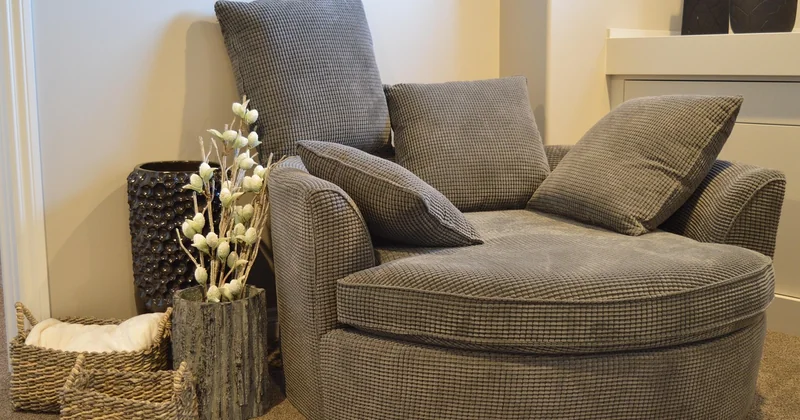
Two measurements decide that. Seat depth—how far back your hips sit relative to your knees—and back support at the lumbar area. A seat that's too deep forces you to slouch or brace. A seat that's too shallow makes you feel like you're perched. Somewhere around the width of your own hand between the back of your knee and the front edge of the cushion tends to work for most adults, though you should test it with your own body rather than trust a number.
And here's a comparison I wish someone had handed me when I started buying for this corner:
| Option | Best for | Trade-off | Footprint |
|---|---|---|---|
| Wingback or high-back armchair | Enclosure, sound absorption, long sessions | Expensive, hard to move, needs floor space | Large |
| Chaise or daybed insert | Stretching out, reading in bed-adjacent posture | Encourages napping more than reading | Large |
| Beanbag with a backrest | Small flats, kids' rooms, movable nooks | Poor lumbar support after an hour | Small |
| Window bench with cushions | Built-in look, storage underneath | Requires carpentry or an existing ledge | Medium |
| Floor cushion plus wall | Nearly zero budget, renters | Hard on the back for long reads | Minimal |
I've used four of those five. The floor cushion was my first attempt and it lasted about three weeks before my lower back filed a complaint. The armchair is what I use now, and it's the only piece of furniture in my home I'd replace with an identical one if it broke.
Small spaces and rentals: how to build the nook without touching the walls
If you can't drill, paint, or mount anything, you have more options than you'd think. The trick is to create boundaries with objects that sit on the floor rather than attach to the wall.

- A rug marks the territory. Even a cheap one. The moment a rug appears, the area reads as a separate room.
- A folding screen gives you a visual wall and absorbs a surprising amount of sound. Mine cost less than a takeaway dinner for four and I've moved it between three apartments.
- A curtain on a tension rod works in doorways and alcoves, and it disappears the moment you take it down.
- A tall bookshelf placed perpendicular to the wall can carve a corner out of an open-plan room without any fixing at all.
- Height changes help too. If the nook sits on a slightly raised platform, or the floor there is a different material, your brain registers the shift.
This is where the DIY reading nook crowd and the small-space crowd overlap almost completely. Neither group can rely on architecture. Both have to fake it with soft goods.
Textiles, and the part almost nobody mentions: sound
Coziness is partly acoustic. I'm convinced of it. A corner with a wool throw, a heavy curtain, and a shelf full of books feels calmer than an identical corner with bare walls, and the difference isn't just visual—the soft materials kill the echo that makes a room feel exposed.
Layer on purpose, cheap on purpose. A thick throw over the back of the chair. One firm cushion for lumbar support and one soft one to hold. A small blanket folded on the floor for cold evenings. None of this needs to match. My current setup has a grey throw, a mustard cushion I bought on a whim, and a rug with a pattern I don't especially like. It works because the textures are varied, not because the palette is curated.
What about a nook for kids?
Children need the same three things adults do—light, enclosure, softness—but scaled down and made slightly more forgiving. A canopy or a tent-style structure does the enclosure work. Low shelving at child height means they can reach their own books without asking. And skip the glass lamp: an LED that stays cool to the touch is the safer call in a room where a seven-year-old will absolutely knock something over. The cordless, rechargeable clip lights you can now find are ideal for this, and they've largely replaced the old plug-in options in most homes I've visited.
The cost reality, without the vague promises
You'll read a lot about how little this costs. That's only half true. The honest version is that a nook can be assembled in tiers, and each tier buys you a different amount of comfort.
- Tier one, nearly free. A chair you already own, moved. A lamp from another room. A blanket from the closet. This gets you maybe 70% of the way there, and it's where I'd start.
- Tier two. One proper warm bulb, one rug, one throw you actually like. This is the tier that turns a pile of objects into a place.
- Tier three. A dedicated chair or bench, a screen or curtain for privacy, a small side table at the right height for a cup.
Most people I've helped with this stop at tier two and are perfectly happy. Tier three is for people who've realized they'll be spending serious hours there and want the geometry to fit their body exactly.
What none of the tiers require is a renovation. Not one of them.
What to do this weekend
Don't build the whole thing at once. That's the advice I'd give if you asked me in person, and it's the opposite of what most guides suggest.
Move one chair to the spot you already drift toward. Angle a lamp at it. Sit there for twenty minutes with a book and see what annoys you. Too dark? Too bright from the side? Back aching? Cold ankles? Each complaint points to a single fix, and each fix costs less than the last.
Three weeks from now you'll have a nook that fits your actual body and your actual habits, rather than a photograph of someone else's corner. And one evening you'll look up from a page, realize it's been dark for an hour, and not remember turning the lamp on—because you didn't. You just sat down, and the room did the rest.


