

The lighting mistakes that make rooms feel smaller (and how to fix them in an afternoon)
A client once asked me to help her "make the living room bigger." She'd already knocked down a wall, repainted everything in a warm off-white, and sold half her furniture on a marketplace site. The room was objectively larger than before. It still felt like a closet. I walked in, looked up, and saw the problem immediately: a single ceiling fixture dead center, throwing light straight down like an interrogation lamp. Every corner of the room was dark. The walls dissolved into shadow. She'd spent thousands on a renovation and lost the effect to a fixture that cost less than a decent dinner.
This happens constantly. People treat lighting as an afterthought, something you pick out at the end once the "real" design decisions are made. That's backwards. Light is what tells your eye where the room ends, how tall it is, and how far back the walls sit. Get it wrong and you can shrink a generous space by what feels like a third. Get it right—with the same furniture, the same paint, the same footprint—and the exact same room reads noticeably bigger.
The good news is that almost none of these fixes require an electrician or a weekend of drywall dust. Most of them are about placement, brightness, and color temperature. Let's go through the ones I see most often and what to do instead.
Key Takeaways
- A single central ceiling light is the number one culprit—it lights the floor and abandons the walls, corners, and ceiling.
- Walls are the surfaces that define how big a room feels. If they're dark, the room shrinks.
- Cool white light (5000K and up) makes a space feel clinical and compressed. Warm light (2700–3000K) reads softer and larger.
- You don't need more watts. You need more point sources at lower intensity.
- Hanging a fixture too low or too high both hurt—it either blocks sightlines or leaves the upper third of the room in gloom.
- The fix is usually cheaper than the mistake: swapping bulbs and adding two lamps can transform a room.
Why one big light shrinks a room
Here's the thing nobody tells you when you're standing in a lighting aisle: your eye doesn't measure square footage. It measures contrast and gradient. When light comes from a single source overhead, it creates a bright pool on the floor and hard shadows everywhere else. Your brain reads those hard shadows as walls closing in.

The shadow problem
Dark corners are the enemy. A room with four shadowed corners and one bright center looks like a stage, and stages feel small and enclosed. When I first started paying attention to this, I tested it in my own apartment. Same room, same furniture. First I lit it with the ceiling fixture only. Then I added two floor lamps angled toward the corners and left the ceiling light off. Guests walked in and asked if I'd moved. I hadn't moved anything.
What changed was the gradient. Soft, overlapping light from multiple directions means shadows are diffuse rather than sharp. The eye can't find a hard edge to interpret as a boundary, so the room reads as open.
Light the walls, not just the floor
Most people aim light downward. But it's the walls and ceiling that carry the perception of volume. A wall that's lit evenly reads as further away; the same wall in shadow reads as closer. Banking a little light upward—a wall sconce, an uplight tucked behind a plant, a floor lamp pointed at the ceiling—lifts the apparent height of the room. I'm convinced this single move does more for a space than any paint color, and I'll defend that position.
Color temperature and brightness mistakes
Two rooms, identical in every dimension, can feel radically different in size based purely on the Kelvin rating of the bulbs. This is where a lot of people go wrong without realizing it's even a variable.

The cool white trap
Cool white light, roughly 4000K to 5000K, mimics overcast daylight. It has its place in garages and workshops. In a living room or bedroom, it flattens everything and makes a space feel tight and exposed at the same time. Warm white, around 2700K to 3000K, feels softer and, counterintuitively, more spacious because it plays better with shadows.
I made this mistake for years. I bought a pack of "daylight" bulbs because they seemed brighter and more efficient. My living room always felt slightly hostile and I couldn't figure out why. It was the bulbs. Swapping them out took ten minutes and cost about the price of lunch.
More light is not the answer
Brightness doesn't equal openness. A room blasted with a single high-output fixture looks harsh, not large. What matters is the distribution. Three 40-watt-equivalent sources spread around a room will feel bigger than one 120-watt source in the center, even though the total output is identical. Aim for layering rather than a single blast.
- Ambient layer: the general wash of light—usually 2700–3000K, dimmable, spread across several fixtures.
- Task layer: brighter, more focused light where you read or work—the reading lamp, the desk lamp.
- Accent layer: the small lights that sketch the room's edges—sconces, shelf lights, a string of warm bulbs behind a headboard.
| Mistake | What it does to perceived size | Cheap fix |
|---|---|---|
| Single central ceiling light | Shrinks room, hard shadows | Add 2–3 lamps, use ceiling light only as accent |
| Cool white bulbs (4000K+) | Flattens, feels clinical | Swap to 2700–3000K warm bulbs |
| Dark wall corners | Walls read as closer | Uplight or wall sconces |
| Fixture hung too low | Blocks sightlines, lowers ceiling | Raise it 6–12 inches |
| Recessed lights against the wall | Harsh scallops, dark gaps | Pull them in, space them evenly |
LED lighting mistakes that make rooms feel smaller
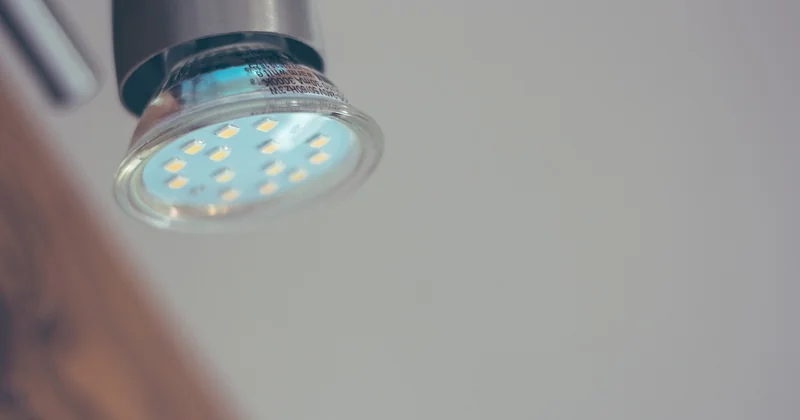
LEDs solved the energy problem and created a new one. The early generations were harsh and directional, and a lot of the cheap ones still are. If you've swapped every bulb in the house for LEDs and something feels off, the bulbs are probably working against you.
The directional beam problem
Many LED fixtures, especially recessed downlights and spotlights, throw a narrow cone of light. That cone creates a bright circle on the floor and leaves everything else dark. Space them badly—too close to the walls, or in a grid that ignores how you actually use the room—and you get a ceiling dotted with bright spots and a room full of shadow. Check the beam angle on the packaging. For general room lighting, wider is usually better; narrow beams belong over specific task areas.
The flicker and CRI issue
Cheap LEDs can flicker at a frequency your conscious eye doesn't catch but your nervous system does. The room feels uneasy. And low CRI (color rendering index) makes colors look muddy and flat, which drains a space of depth cues. Look for CRI 90 or higher on anything you spend real time under. It's a spec, like Kelvin, that most shoppers ignore and then blame on the paint.
Don't mix color temperatures
One of the worst things I've seen in clients' homes: a warm bulb in one lamp, a cool bulb in the next. Your brain reads that inconsistency as clutter, and clutter makes rooms feel smaller. Pick one temperature for the whole space—2700K is a safe bet for most living areas—and stick to it across every fixture.
Outdoor lighting mistakes that make rooms feel smaller
This one sounds strange until you think about sightlines. What you see through a window is part of how your brain judges the room. If the view outside is a dark void, the room ends at the glass. If it's softly lit—a porch light, some path lighting, an illuminated tree—the room seems to extend outward.
The black hole window
At night, an unlit exterior turns every window into a black rectangle. That rectangle reads as a wall, not an opening. What's bizarre is how many people light their living rooms to the nines and leave the yard pitch dark, then wonder why the space feels closed. Add a low-level outdoor fixture—nothing dramatic, just enough to give the window depth—and the room breathes.
Glare working against you
Bright, bare outdoor lights pointed back at the house create glare on the inside of the glass. That glare blocks the view and, worse, reflects into the room, breaking up the light layering you worked so hard to build. Use shielded fixtures, aim them down or away, and keep the exterior light level lower than the interior. Contrast makes the window read as a portal instead of a mirror.
A quick diagnostic you can run tonight
Turn off everything. Stand in the doorway of the room. Turn on one light source at a time and watch how the room's edges shift. Then turn them all on together and note which corners are still dark. Those corners are where you need the next fixture. This takes five minutes and will tell you more than any lighting showroom ever will.
How to fix it without rewiring
You don't need to rip out your ceiling or hire a contractor for most of this. Here's the order I'd work in, cheapest and fastest first.
- Swap every bulb in the room to the same warm temperature. This is the single highest-impact, lowest-cost change you can make.
- Add two lamps positioned to reach the corners the ceiling light misses. Aim one slightly up.
- If you have recessed lights, check their spacing. Pull-out or reposition where you can, or simply stop relying on them alone.
- Put a small uplight or sconce on at least one wall to lift the ceiling's perceived height.
- Add a low outdoor light outside the most-used window at night.
- Put everything on dimmers if you can. Dimmers let you tune the layers to the time of day.
I've done this sequence in three apartments and one house now, and the result has been consistent: the space feels larger within a day, without moving a single piece of furniture. The total spend has ranged from about the cost of a nice dinner to a few hundred dollars depending on how many fixtures I added.
What to check before you buy anything
If you take nothing else from this: look at the Kelvin rating and the CRI before you look at the fixture itself. Those two numbers decide whether a room reads as open or boxed in, and they're printed on nearly every box. The design of the lamp is secondary.
The mistake almost everyone makes is treating light as decoration—the pretty thing you notice last. It isn't. It's the tool that decides whether the walls feel like they're eight feet away or twelve. Same room, same stuff, completely different sense of space. The only variable that changed was where the light came from and what color it was. Next time a room feels cramped, don't reach for the paint swatches. Look at the ceiling and ask what's casting the shadows in the corners.


